

June 2026 – Recent developments in sorting technologies, system design and operational strategies are improving the recovery of films and flexible packaging at MRFs.
The Challenge
Film and flexible packaging (FFP) have long challenged material recovery facilities (MRFs) due to contamination, equipment fouling and limited end-market demand. But recent developments in sorting technologies, system design and operational strategies are improving the recovery of films and flexible packaging at MRFs. Mechanical separation and innovative preprocessing approaches can help properly prepare film and flexibles to be processed by sensor-based optical sorting. Advances in optical sorting are making film easier to identify and separate. This improved sorting performance is making recycled film a viable option when aligned with evolving end-market specifications, extended producer responsibility initiatives and recycled-content goals.
The Target
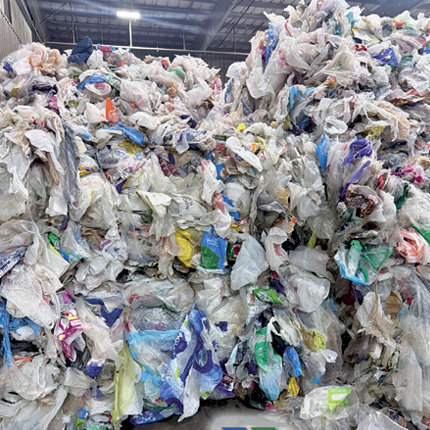
Increased demand for FFP bales prompted FCC Environmental Services to make improvements to its Houston MRF. With a high volume of incoming film material, the MRF already had some equipment for film recovery and was seeing contamination levels of 20-25% in its film bales. To better align with evolving end-market specifications, the facility targeted contamination levels below 5% in those bales.
The Retrofit
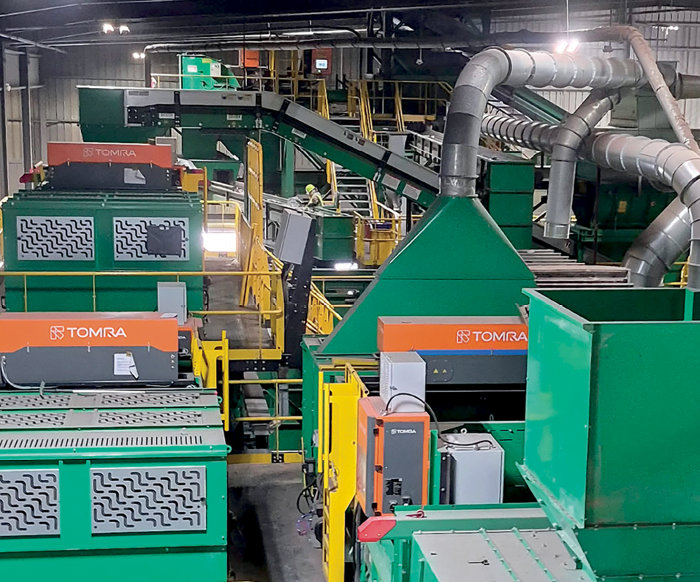
 To make this retrofit possible, Van Dyk Recycling Solutions supplied key equipment to capture film from the MRF’s paper line and further sort it to achieve that high purity rate. Three TOMRA optical sorters were added to perform multiple rounds of sorting on the film fraction. The first optical sorter ejects all nonpaper from the paper stream and uses a suction hood to extract film from the ejected fraction. The second optical sorter performs quality control on the extracted film by positively shooting on film, while the third performs final cleanup by ejecting all nonfilm, leaving a super clean, double-sorted film product. The opticals are equipped with the latest technologies to separate fiber and containers from film, including disc spreaders to properly singulate material, and aeroboost to keep material stable and allow the sensor to effectively sort and recover film. Special Z conveyors from Lubo were used to achieve unique angles and overcome space restraints in transferring the final paper and film fractions throughout the new equipment.
The Result
Following the retrofit, the facility has achieved film contamination levels below the 5% target, with some operating periods reaching approximately 3% contamination. Additionally, the extra sorting steps not only allow the MRF to make clean film but produce three positive byproduct results. First, by assigning quality control functions to the new optical sorters, the facility was able to reduce the number of hand-sorters by four per shift. Second, the double-sorting allows FCC to recover valuable recyclables that would otherwise be contaminating the fiber stream, such as PET and aluminum. And third, the fiber product that FCC generates now approaches ReMA’s ISRI specification with less than 2% prohibitives, producing a more salable fiber fraction.
Does your MRF process large volumes of film and flexible packaging? Van Dyk has innovative solutions to recover film and flex from any stream. Contact us today to discuss a solution that fits your unique situation and achieves your processing goals.
As seen in Recycling Today.