

Buzz around AI is everywhere, but the buzz often lacks concrete examples to demonstrate exactly how AI would be worth your investment. With just a few Greyparrot Analyzers, you can quantify value loss in your residential single-stream recycling operation down to the dollar. Here are five real-world examples to show how Greyparrot Analyzers work to save you money—and how much.
Van Dyk Recycling Solutions is the exclusive supplier of Greyparrot Analyzers and systems in North America.
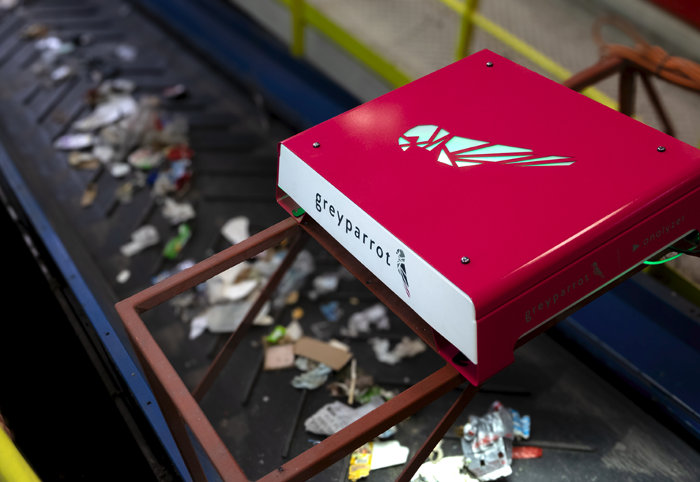
Get transparency on incoming loads
When placed on the infeed line(s), Greyparrot Analyzer can monitor your inbound stream and perform automated audits, so you know what each customer’s material looks like in real time. What are they really bringing you? Can you adjust their tip fee based on the quality of their loads?
Improve recovery by monitoring the outbound end-of-line residue
Greyparrot Analyzer monitors recyclables that are lost to residue. This reveals how successful your system is at recovering what is coming in and calculates how much valuable material you are losing. If you knew how much value you are losing on a daily basis, wouldn’t you implement a strategy to improve recovery?
Know the exact quality of your PET—with the receipts to prove it
Monitor the quality of your PET every day, up to the minute. Analyzer alerts you instantly if your PET quality drops below spec. But it also provides you with concrete data when your bales meet or exceed spec. Imagine the ability to send your end-user customer the equivalent of a Carfax, backed by real-time data, detailing bale quality before buying. If you can prove you make consistently better quality than others, your material will be chosen ahead of other suppliers every time—especially in down markets.
Stop losing aluminum to the mixed paper
Mixed paper is historically the lowest-value fiber grade, but because of its fraction size, it is most likely to be contaminated with material that is equal in value or much more valuable than the mixed paper itself. Even if contaminated mixed paper bales are sellable, wouldn’t you like to monitor what the contamination is made of? Contamination is typically in the form of items 5 inches or less in size, often PET or aluminum, which is selling at a 12-month average of $1,640 per ton*. If you are selling mixed paper bales at $43 a ton*, but your system is letting 1 ton of aluminum slip into the mixed paper every day, that’s $1,597 worth of aluminum lost that day. Wouldn’t you want to know that immediately, before you send $36,731 of aluminum to the paper mill throughout the rest of the month?
Maximize recovery of HDPE-Natural
Greyparrot Analyzer can distinguish natural vs. colored HDPE, in real time, to quantify how much HDPE-N is being lost to your HDPE-C. Why is this important? HDPE-C sells for an average of $85 per ton*. HDPE-N is enjoying a 12-month average value of $1,251 per ton*. If 1 ton of HDPE-N is leaving your facility daily in the HDPE-C bales, that’s $26,818 lost in a month. Wouldn’t you want to identify that value loss on the first day and take immediate action to save up to $25,652 for the rest of the month?
No two plants are the same. Let Van Dyk consult with you on a package of Greyparrot Analyzers that fits your operation. We have customers currently operating packages anywhere from three Analyzers up to 22 Analyzers. Every single one is seeing the value in the data revealed. Get total visibility into your plant and take control of your profits—contact us today.
*Commodity values based on RecyclingMarkets.net 12-month national average.
As seen in Recycling Today.