

Oliver Mills, Global Sales Director, Centriair
Per Kaijser, Co-Founder and Director of Sales and Marketing, Centriair
Brian Schellati, Director of Business Development, Van Dyk Recycling Solutions
Centriair is a Swedish company with 20 years of experience in odor control for the waste business. For 15 years Centriair’s main focus has been in biogas and municipal solid waste processing: collection, sorting, slurry conversion, digestion and digestate treatment, and often composting. Centriair systems are sold in North America under the product portfolio of Van Dyk Recycling Solutions.
Designing odor control installations for each plant’s need
The first step is to gather all information regarding the plant, the building, and the processes in the plant. This includes the volumes and types of waste or substrate handled, the type of machinery and the sizes of the plant’s receiving halls or tipping floor. The aim is to identify particularly challenging air sources in the plant and to determine if special treatment is needed for these. This is mainly in regard to the emission limits, i.e. odor reduction (keeping neighbors happy). However, we also need to consider the working conditions in the plant and the ways in which air is circulated in the building to ensure that no harmful or annoying concentrations of gases or odors occur, providing a safe working environment for the staff. We treat these two parts as separate work streams, where the air circulation is more tied to the duct design.
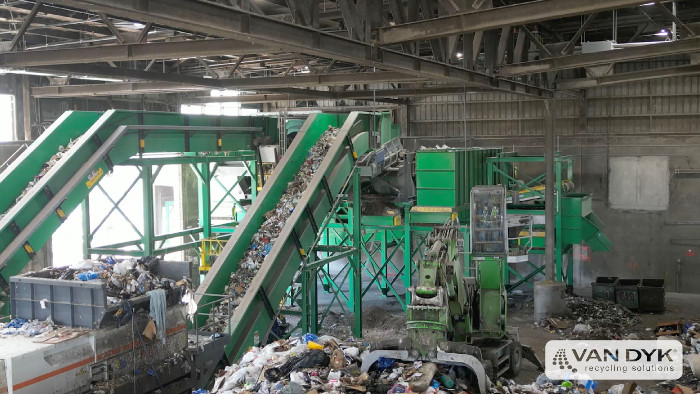
Indoor ventilation vs Outdoor extraction: Improving indoor air quality through building ventilation
This work is done in close cooperation with the architects and building designers. The aim is to optimize the ventilation and airflow in the building to achieve a high air quality in all parts of the building. Special attention is paid to areas where staff is frequently present. Processes and equipment that create odors need point extractions. The airflow should be designed so that cleaner air travels towards these pollutant sources and is then extracted in close vicinity. At a higher level, the air change rates are determined. Again, this will vary with the activity level and type in each part of the building. Certain areas, such as pump and heat exchanger rooms, can have relatively low air change rates, whereas other areas with polluting sources should have higher air change rates. Rate of staff presence is also taken into account.
A separate part of the building ventilation design is the heating. For plants in areas with a high heating need in winter, heating and possibly recirculation of the air in the plant needs to be considered. Normally only limited parts of the plants need full heating and there should be parts where excess heat is being generated. Where possible, we can use the excess heat in other parts of the building.
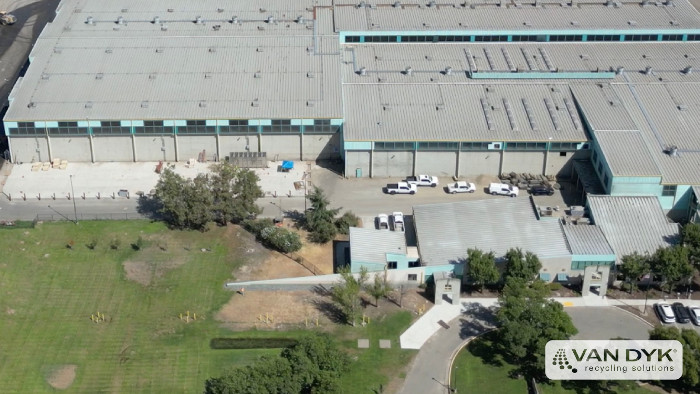
Indoor ventilation vs Outdoor extraction: External odor reduction
For external odor reduction we use the facts gathered regarding the plant operation and the air extraction volumes established and analyze these carefully against the site permit limit on odor emission.
The site permit limit is usually defined as a stack odor emission value, but it can also be given as a concentration to the nearest recipient (nearest neighbour). Typical stack values are 500 or 1000 OU/m3 (OU means Odor Units and is the standard for Odor concentration measurement) and nearest recipient 3-5 OU/m3. The conversion from nearest to stack value is done through odor dispersion modelling—a calculation of how the air emitted through the stack is mixed with fresh air until it reaches the nearest recipient. Specialists are employed to do this calculation properly. What we ultimately need for the dimensioning of the odor treatment or abatement equipment is the stack emission limit, which together with the inlet odor value will define the removal efficiency that is demanded. The inlet odor value is estimated by a survey of the plant, the rate of air extracted (given by the building ventilation design) and the separate odor emission sources in the plant.
For the plant/facility odor emission sources, this ranges from receiving halls (tip floors) in the plant to different point extractions, such as machines or tanks. Centriair has experience with different emission sources from Waste and AD/biogas plants and can identify where the major challenges are.
Once these odor emission sources are identified, we look at the specifics of each source to determine if a separate pre-treatment is needed. Pre-treatment is needed where we have a high concentration and hence contribution of odor from a specific source. By reducing these low airflow high contributors, we reduce the overall total odor load and we make the incoming odor concentration to the main system lower. With a low to moderate incoming concentration, the main system can be chosen with reasonable size, Capex and Opex.
When the pre-treatment has been selected and dimensioned, we have a total odor inlet concentration and the outlet target, so that a dimensioning can be done. This dimensioning is done with a safety margin and with the aim to have service intervals of the active carbon bed between 18 and 24 months.
In the design process we also investigate the need for other types of pre-treatment, for instance for dust or ammonia. These stages are sized to airflow and incoming concentrations. This pre-treatment is needed to ensure we do not have particles and pollutants that reduce the odor treatment efficiency.
Considering these different aspects of your plant will ensure you get an odor treatment system that gives you high air quality indoors as well as no disturbance to your neighbors. For a full site evaluation, contact Van Dyk Recycling Solutions at 203-967-1100 or [email protected].