

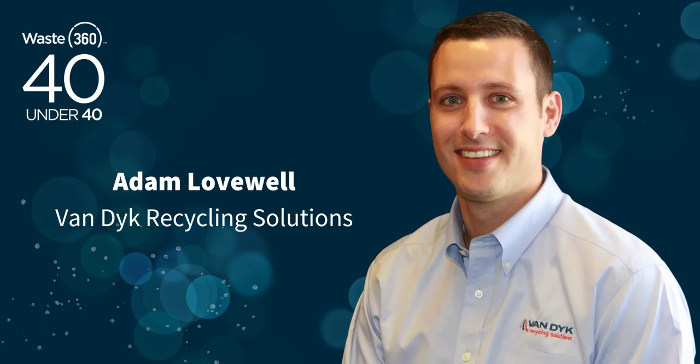
Adam Lovewell, Process Engineer/Sales Manager with Van Dyk Recycling Solutions, serves in the company’s Midwest region. In his role, he has been involved in projects related to dual-stream recycling, single-stream recycling, MSW/fuel systems, PET/plastics sorting, PE film sorting, and advanced recycling systems.
In this Q&A interview, Lovewell, a 2025 Waste360 40 Under 40 Award winner, discusses how he designs systems that solve clients’ complex recycling challenges.
Waste360: What type of clients do you work with?
Adam Lovewell: Anybody in the recycling space, both private and publicly-traded companies. Big names on the publicly-traded side would be Waste Connections, WM, Republic Services, GFL. On the private side, some of the remaining private clients that we have here in the United States.
Waste360: When you’re assigned a project, what are some of the steps, or considerations that you go through to help a client reach a solution?
Adam Lovewell: In this industry, everything is custom-designed and tailored for a unique application or situation. The more straightforward requests we get are for a request for a proposal, where a client already has figured out what they want, and then my job is to come up with an equipment solution that meets or exceeds those goals.
A client might say, we want to process 40 tons an hour of single-stream recycling. We want to recover these different commodities, and it needs to fit in this building. Then it is my job, along with my team, to come up with a unique solution of various pieces of equipment to accomplish that goal.
Another situation might be the client says, I don’t really know what to do, so I need you to help me develop the entire business case to process this material, and to make sellable commodities.
I would say that the third application would really be, the client has an existing facility, and they say, we want to improve recovery, we want to improve quality, we want to reduce manual labor, we want to increase throughput. What can we do to do that? In that case, it involves visiting the site and talking through the client’s existing operations, reviewing the existing layout and equipment. Then, it’s our job, and my job, to come up with a unique solution that accomplishes those goals.
Waste360: How long have you been in the industry?
Adam Lovewell: I’ve been with Van Dyk Recycling Solutions for 10 years, but I’ve been in the industry for 14 years. Prior to joining Van Dyk, I worked for a company called RRT Design and Construction out of Long Island, New York. They have been in business just like Van Dyk for almost 40 years. They were involved in designing, building, operating, originally recycling facilities, and then moved into consulting and engineering work. Four years with them, and 10 years with Van Dyk.
Waste360: What innovations have evolved that have made what you do more efficient over the years?
Adam Lovewell: I would say, it’s the equipment that has evolved. One of the big differentiators between Van Dyk and our competitors is that we don’t manufacture equipment. We supply best-in-class equipment for that application, and then we follow it up with providing all the service and support for that equipment.
That allows us to continue to implement new technology into these systems. We don’t have our hands tied behind our back to only use the equipment that we manufacture. Since we don’t manufacture, it allows us to find new equipment and solutions out there on the market that complement our other technology, which helps the systems evolve, and helps our clients with their operations.
Waste360: What is something that you enjoy about the work that you do?
Adam Lovewell: I have a feeling that everybody in the industry would say this, and it’s that the material that we process, not only is it something that everybody has to deal with on a daily basis—everybody produces trash and recyclables—but the fun and exciting thing is that it’s constantly changing.
The packaging that you use, the quantity of material that you consume. For example, one of the big changes over the last, five or 10 years is what they refer to as the Amazon effect. A lot of people are ordering things online instead of shopping in stores. The material stream has changed to have more cardboard in it.
There is also less newspaper because people aren’t reading the newspaper, they’re getting their mail or their information digitally. The material stream is constantly changing, which requires constant changes to the way that systems are designed, or retrofit, to handle what the industry would refer to as the evolving ton.
Waste360: For your background as an engineer, what type of training, or education, led you to the skills that you have, but then also to this field?
Adam Lovewell: It’s a really good question, because there’s no school that you can go to for this. At least yet. I don’t think there are any classes out there that teach you recycling and solid waste. There are some for landfill training, but in our industry of recycling, it is really all hands-on experience. My background is in industrial and systems engineering, that is what I got my degree in, which is really problem-solving. Being able to look at a system or an operation and figure out how to optimize it.
Every system, every recycling plant in the country, is unique. Everything has a custom design to it. When you walk into one plant and see something, it just might not be the same as the other plant that is even right down the road. Having good problem-solving skills, being able to look at a situation, and go through that scientific process to be able to evaluate, come up with potential solutions, and then ultimately find the best solution for the client at the time… That is how we’ve been successful in our business, and that is how I’ve gotten success in our industry.
Waste360: What are recent projects that you have designed?
Adam Lovewell: I’ve been responsible for designing a number of recycling facilities throughout the country. There are a couple of recent projects, and they are just off the top of my head because we are either finishing up construction or starting them up, or they just recently started up. One of them would be Waste Connections, in Plainfield, Illinois.
We designed and built a 35-ton an hour single-stream recycling facility for them with four manual sorters. In our industry, that’s kind of unheard of. Typically, with a 35-ton an hour system, historically, it was one sorter per ton, so you would have 35 sorters. Over the years, with the new technology, that number has gone down. But the sorter ratio of a little less than nine tons per sorter is something that the industry has never really seen before. It’s a huge advancement to prove what automation and good design can do within this industry.
Another project is a mechanical film recycler. We just finished the startup of this facility, and I believe it’s the largest in North America. It’s a film recycling plant. It takes in flexible film packaging, and sorts it, and ultimately converts it back into a pellet that can be reused for making other plastic products. That is something that hasn’t really been done here at this scale in the United States. That is with a company called Nova Chemicals in Connersville, Indiana.
And then the third one that I just want to mention is with what the industry refers to as advanced recycling. We built a front-end system for Freepoint in Hebron, Ohio. This company sorts end-of-life plastics that have either gone through a MRF, and it’s not one of the target plastic materials or other post-industrial scrap that would ultimately be destined for a landfill. This company takes that material, sorts it, and then converts it back to oil. We were responsible for designing the front-end system for that process to sort all these various grades of plastics and create a fuel for their back-end conversion technology to convert that plastic fuel into oil.
Waste360: Is there anything on the horizon that you would like to mention?
Adam Lovewell: On the horizon is just the continued work in this field of recycling and solid waste. Where things are trending is on the plastics recycling and advanced recycling sides. That’s a combination of mechanical recycling and advanced recycling for this conversion of plastics to oil.
As seen in Waste360.